
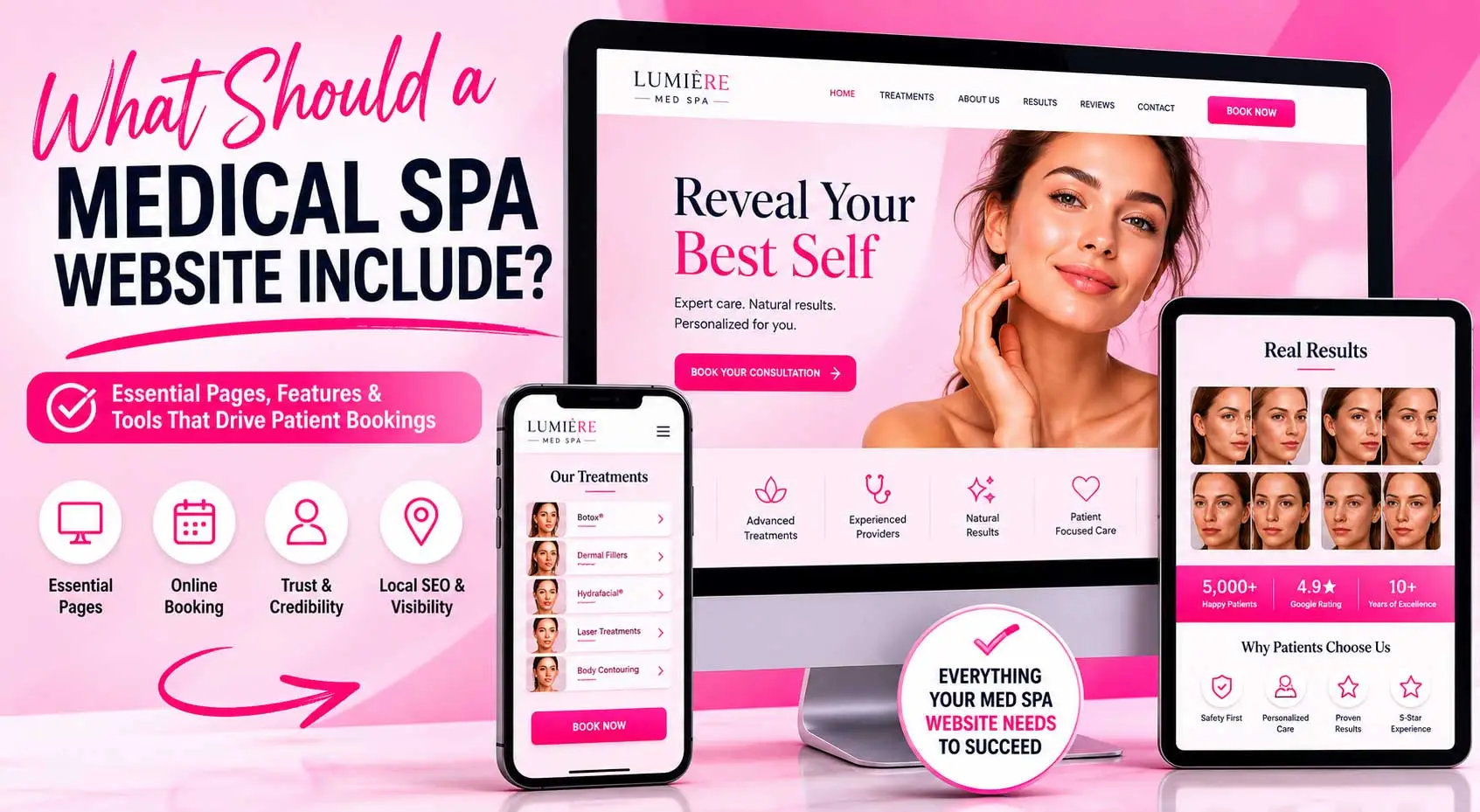
A medical spa website should include a clear homepage, dedicated treatment pages, online booking, before-and-after galleries, provider bios, patient reviews, local SEO content, HIPAA-aware contact forms, and strong calls-to-action. The goal is not simply to look professional. The goal is to help potential patients trust your practice and book a consultation quickly.
A med spa owner recently asked a version of this question in a marketing forum, and the answers ranged from “just use Squarespace” to “spend $20,000 on a custom website.” Both answers are technically true. Neither is useful if you are trying to make a real decision.
The better question is not what platform you should use. It is what your website actually needs to accomplish. Your website is often the first interaction a potential patient has with your practice. Long before they call, book, or visit, they are judging your credibility based on what they see online.
According to the American Med Spa Association, website design directly affects how potential clients perceive professionalism, expertise, and trustworthiness in a medical spa practice.
A successful med spa website functions as a patient acquisition system. Here are the pages and features that matter most.
Table of Contents
- Essential Homepage Elements
- Treatment and Service Pages
- Trust Signals That Increase Bookings
- Online Booking and Lead Capture
- Medical Spa Website Comparison Table
- Real-World Example
- Frequently Asked Questions
- Conclusion
Essential Homepage Elements
Your homepage has one primary job. It must help visitors understand who you are, what treatments you offer, and how they can book.
According to AmSpa’s website design guidance, visitors should immediately see clear navigation, treatment information, booking options, and compelling visuals when they arrive on a med spa website.
The best homepages typically include:
- Clear value proposition above the fold
- Professional photography
- Primary treatment categories
- Online booking button
- Reviews and testimonials
- Before-and-after results
- Contact information
- Location information
Many med spa websites fail because they prioritize appearance over clarity. Beautiful photography helps, but patients still need answers. They want to know what treatments you offer, whether they can trust your providers, and how quickly they can schedule a consultation.
Above-the-Fold Content Matters
The section visible before scrolling should communicate three things within seconds:
- What your med spa does
- Where you are located
- How visitors can book
Visitors should never have to hunt for basic information.
If your homepage forces users to click through multiple pages before finding treatment information or booking options, conversion rates typically suffer.
Treatment and Service Pages
One of the biggest mistakes med spas make is placing every treatment on a single services page.
Each major treatment should have its own dedicated page.
According to medical spa SEO specialists, dedicated service pages improve local search visibility and help practices rank for treatment-specific searches such as Botox, fillers, laser resurfacing, or body contouring.
Common service pages include:
- Botox
- Dermal Fillers
- Hydrafacial
- Laser Hair Removal
- Microneedling
- Chemical Peels
- Body Contouring
- IV Therapy
Each treatment page should explain:
- Who the treatment is for
- Expected results
- Recovery time
- Frequently asked questions
- Pricing guidance if appropriate
- Before-and-after photos
- Consultation CTA
Why Individual Pages Matter for SEO
When someone searches “Botox in Scottsdale” or “Hydrafacial near me,” Google prefers highly relevant pages.
A dedicated Botox page has a much better chance of ranking than a generic services page that mentions Botox once.
This is one reason location-based treatment pages perform so well for growing med spas. Practices targeting multiple markets often create dedicated city-specific pages such as:
- Scottsdale Botox
- Austin Hydrafacial
- Nashville Laser Hair Removal
This structure helps capture local search demand while improving relevance.
Trust Signals That Increase Bookings
Medical aesthetics is a trust-driven industry.
Patients are not buying a product. They are choosing who will perform a procedure on their face or body.
That means trust signals are essential.
According to med spa website design recommendations published by AmSpa, provider information, before-and-after galleries, and educational content significantly improve credibility and engagement.
Provider Bio Pages
Every injector, physician, nurse practitioner, and specialist should have a dedicated profile page.
Include:
- Professional credentials
- Certifications
- Experience
- Treatment specialties
- Professional headshots
Patients often research providers before booking.
Before-and-After Galleries
Before-and-after photos remain one of the strongest conversion tools available.
Potential patients want proof that your treatments work.
Use high-quality, consistent photography with proper consent and compliance practices.
Reviews and Testimonials
BrightLocal consistently reports that online reviews play a major role in local purchasing decisions. Potential patients often compare multiple providers before scheduling consultations.
Displaying reviews throughout your website reinforces credibility while supporting local SEO efforts.
Wondering how your website compares to competitors in your city?
Get your free Brand Visibility Score in two minutes. It analyzes your med spa’s online presence and shows exactly where you are losing patients to competitors. No email gate. No sales call.
Online Booking and Lead Capture
Many med spas spend thousands of dollars driving traffic to their websites but make booking difficult.
That creates friction.
According to AmSpa’s website design recommendations, booking should be easy and visible throughout the site. Visitors should never struggle to schedule a consultation.
Your website should include:
- Online consultation requests
- Mobile-friendly booking forms
- Click-to-call functionality
- SMS contact options
- Contact forms
- Appointment scheduling integration
Mobile Experience Is Critical
Most visitors now browse on mobile devices.
AmSpa specifically highlights mobile responsiveness as a core requirement for medical spa websites.
Buttons should be easy to tap.
Forms should require minimal typing.
Booking should take less than a minute.
HIPAA-Aware Forms
If patient information is collected online, your forms should follow healthcare privacy requirements.
The U.S. Department of Health and Human Services provides guidance on HIPAA privacy and patient information handling. Practices should review applicable requirements when implementing online forms and patient communications.
Medical Spa Website Features Comparison
Not every website element has equal impact.
Here is how the most important features compare.
| Feature | Why It Matters | Impact on Conversions |
|---|---|---|
| Dedicated Treatment Pages | Improves SEO relevance | High |
| Online Booking | Reduces friction | High |
| Before-and-After Gallery | Builds trust | High |
| Provider Bios | Establishes expertise | High |
| Patient Reviews | Social proof | High |
| Blog Content | Supports SEO | Medium |
| Video Content | Improves engagement | Medium |
| Live Chat | Speeds response times | Medium |
| FAQ Section | Addresses objections | Medium |
| Location Pages | Improves local rankings | High |
The biggest takeaway is that aesthetics alone do not generate appointments. Pages that improve trust, answer questions, and simplify booking typically produce the strongest results.
Real-World Example
A growing med spa with two locations approached a website agency after experiencing stagnant lead volume.
The practice had a visually attractive website, but it lacked dedicated service pages, provider bios, and local landing pages. Most treatment information was condensed into one generic services page.
The redesign focused on five changes:
- Individual treatment pages
- Dedicated provider profiles
- Before-and-after galleries
- Mobile booking improvements
- Local SEO landing pages
Within several months, organic visibility improved because treatment-specific pages aligned more closely with patient searches. Consultation inquiries increased because visitors could find relevant information faster.
The website did not become successful because it looked different. It became successful because it answered more questions and reduced booking friction.
That distinction matters.
Frequently Asked Questions
Are before-and-after photos necessary?
For most aesthetic treatments, yes. Before-and-after galleries help potential patients evaluate results and build trust. They are often among the most visited pages on medical spa websites.
Does a medical spa need a blog?
A blog helps support SEO and patient education. Articles answering common treatment questions can attract traffic from Google and AI search platforms while establishing authority.
What is the most important feature on a med spa website?
Online booking is one of the highest-impact features. Patients expect convenience. If scheduling is difficult, many visitors leave and book with another provider.
Should a med spa website be mobile-first?
Absolutely. Most users browse healthcare and beauty-related services from mobile devices. Mobile responsiveness affects both user experience and search rankings.
Do med spas need city-specific landing pages?
If you serve multiple locations or want stronger local rankings, city pages can be extremely effective. They help target searches that combine treatment names with geographic locations.
The Bottom Line / Conclusion
A medical spa website should do far more than look attractive. It should help visitors trust your practice, understand your treatments, and schedule consultations without friction.
The highest-performing med spa websites consistently include dedicated treatment pages, provider bios, before-and-after galleries, patient reviews, mobile-friendly booking tools, local SEO content, and clear calls-to-action.
What most owners get wrong is focusing exclusively on design. Patients care about design, but they also care about convenience, credibility, and clarity.
If your website does not answer questions quickly or make booking easy, even beautiful design can underperform.
Ready to build a med spa website that actually generates patient leads?
Digital Mounts builds custom medical spa websites for a flat $7,500, delivered in 30 days, with up to 100 city-by-treatment landing pages, AI-search-ready architecture, and HIPAA-aware booking integration. No retainers. You own everything.