
Medical Spa Website Chatbots: Do They Help?
Yes, chatbots and live chat can help medical spa websites generate more patient leads, but only when they are implemented correctly. Most med spas benefit more from fast-response live chat during business hours than from generic AI chat widgets. The best-performing setups answer pricing questions, guide visitors toward consultations, and reduce response delays without replacing human interaction.
A med spa owner recently asked a version of this question in a marketing forum, and the answers ranged from “chatbots doubled our leads” to “patients hated it and bounced.” Both answers are technically true. Neither is useful if you are trying to make a real decision.
The reality is that most chatbot software was not built specifically for aesthetic clinics. A medical spa website has a different trust dynamic than a typical ecommerce site. Patients are often considering Botox, fillers, laser procedures, or body treatments that involve appearance, privacy, pricing anxiety, and medical credibility.
That changes how website visitors behave.
Adding a chatbot simply because “everyone else is doing it” rarely works. Adding the right chat experience at the right stage of the patient journey can improve consultation requests, shorten response time, and reduce abandoned leads.
Table of Contents
- What Chat Tools Actually Do for Med Spas
- Where Chatbots Improve Conversion Rates
- Why Some Med Spa Chatbots Fail
- Live Chat vs AI Chatbots for Medical Spas
- What the Best Med Spa Websites Do Differently
- Comparison Table
- Frequently Asked Questions
- The Bottom Line
What Chat Tools Actually Do for Med Spas
Most med spa owners think chat tools exist mainly to “answer questions.” In practice, their real job is reducing friction between website visits and booked consultations.
According to BrightLocal’s local consumer behavior research, 98% of consumers used the internet to find information about local businesses in 2024. BrightLocal That means your website often becomes the first interaction a potential patient has with your clinic.
The problem is timing.
A prospective patient might land on your website at 10:30 p.m. after searching for “Botox near me” or “lip filler consultation.” If your only contact option is a generic form that promises a callback “within 24 hours,” many visitors leave before submitting anything.
Chat systems reduce that hesitation by creating immediate interaction.
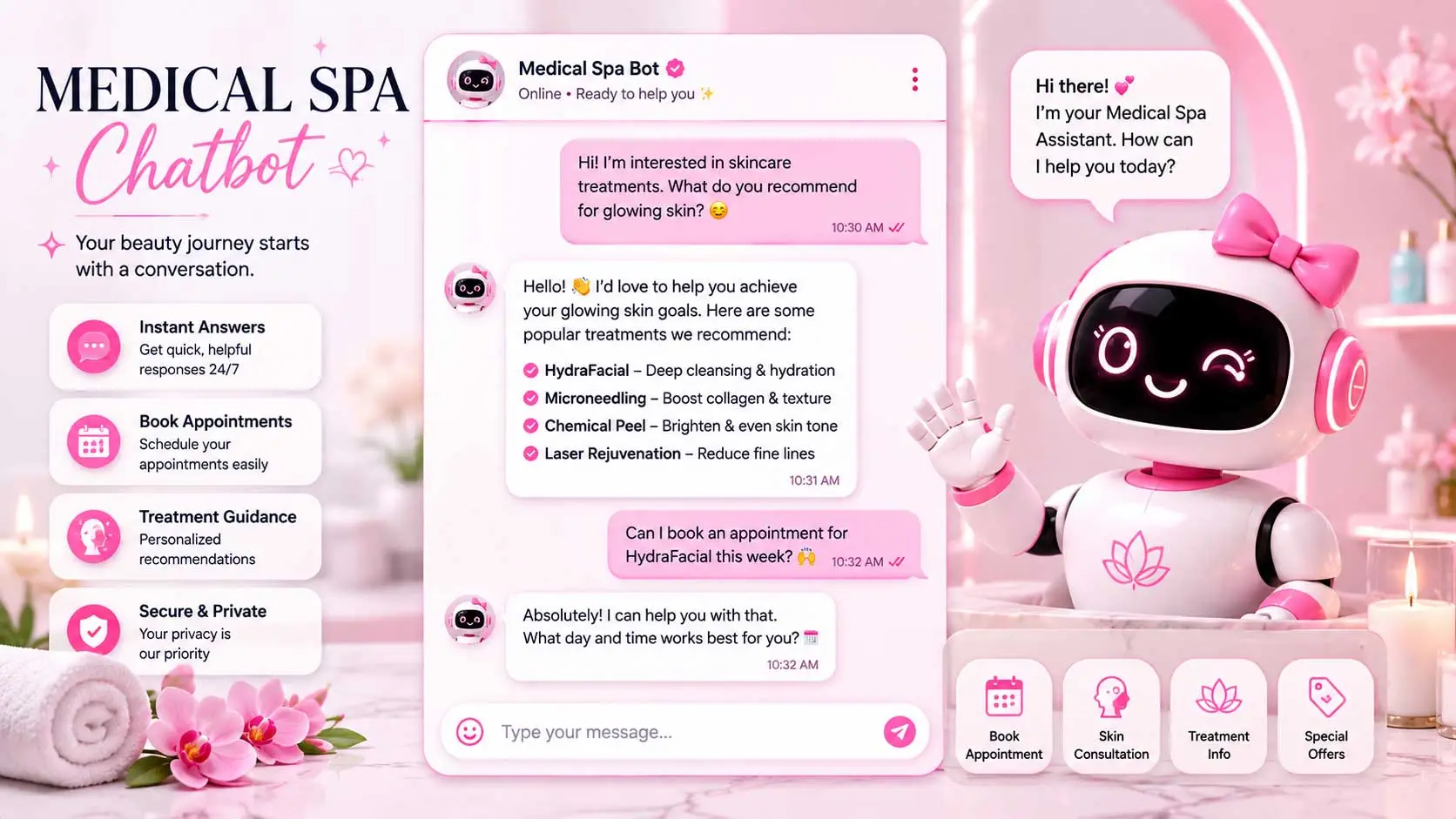
For med spas, the most useful chatbot functions usually include:
- answering basic treatment questions
- collecting consultation requests
- routing visitors to booking pages
- sharing financing information
- explaining treatment timelines
- qualifying leads before staff follow-up
The strongest setups also integrate directly into your CRM or booking system so your front desk team is not manually chasing scattered inquiries.
This matters because response speed directly affects conversion. According to HubSpot research, lead response times heavily influence conversion outcomes, especially for service businesses. HubSpot
The difference between “support” and “sales”
Many med spa owners install chat widgets as passive support tools. High-performing clinics use them as guided conversion systems.
That distinction matters.
A weak chatbot says:
“Hi. How can I help?”
A strong chatbot says:
“Interested in Botox, fillers, laser treatments, or skincare? We can help you choose the right consultation.”
One creates confusion. The other creates direction.
Where Chatbots Improve Conversion Rates
Chat tools work best when they solve specific patient hesitations.
The highest-converting med spa websites typically use chat systems in three situations: pricing uncertainty, booking hesitation, and after-hours lead capture.
Pricing questions are especially common in aesthetics. According to the American Med Spa Association, treatment costs vary widely by geography, provider experience, and treatment type. AmSpa Patients often visit multiple websites before deciding who to contact.
A chatbot can reduce drop-off by handling early-stage concerns such as:
- “How much does Botox usually cost?”
- “Do you offer financing?”
- “How many sessions will I need?”
- “Can I book online?”
- “Do you treat men?”
The key is moderation.
The chatbot should guide visitors toward consultations, not attempt full medical advice. According to the U.S. Department of Health & Human Services HIPAA guidance, healthcare-related communication systems should carefully protect sensitive patient information. HHS HIPAA
That means your chatbot should avoid collecting unnecessary medical details.
Another major advantage is lead capture outside office hours. Many med spas lose potential patients simply because nobody responds quickly enough.
According to Google’s business guidance, users increasingly expect immediate answers during local search journeys. Google Search Central A delayed response often means a lost lead.
Why Some Med Spa Chatbots Fail
There is a reason many med spa owners remove chat widgets after a few months.
Most implementations are poorly timed, overly aggressive, or obviously automated.
Patients visiting aesthetic clinic websites are often making appearance-related decisions tied to confidence and trust. A robotic popup that appears five seconds after page load can feel intrusive instead of helpful.
The most common chatbot mistakes include:
- aggressive popups
- fake “human typing” simulations
- generic AI responses
- poor mobile usability
- asking for too much information too early
- no human escalation option
These problems hurt trust.
According to a report from Salesforce, customers expect conversational systems to feel connected to real support when necessary. Salesforce When visitors feel trapped inside automation, conversion rates often decline.
Mobile experience matters more than desktop
Most med spa traffic now comes from mobile devices. Statista reports that mobile internet usage continues to dominate overall web traffic worldwide. Statista
Unfortunately, many chatbot tools are still designed poorly for mobile layouts.
You have probably seen this yourself. The chat bubble blocks the booking button. The widget covers treatment pricing. The popup interrupts scrolling.
Those small usability issues create friction at the exact moment visitors are deciding whether to contact your clinic.
Wondering if your website is quietly losing leads before patients ever contact you?
Get your free Brand Visibility Score in two minutes. It analyzes your med spa’s online presence and shows exactly where you are losing patients to competitors. No email gate. No sales call.
Live Chat vs AI Chatbots for Medical Spas
This is where most med spa owners ask the wrong question.
The real decision is not “Should I use AI?” The real question is “Where should automation stop and human interaction begin?”
For most clinics, hybrid systems work best.
Live chat performs well during business hours because med spa patients often want reassurance from a real person before booking treatments. This is especially true for higher-ticket services like body contouring, laser resurfacing, and injectables.
AI chatbots perform best when:
- answering basic FAQs
- capturing after-hours leads
- routing users to service pages
- pre-qualifying consultation requests
- handling repetitive scheduling questions
Human chat performs best when:
- discussing pricing nuance
- handling objections
- addressing anxiety
- explaining provider expertise
- managing consultation concerns
The strongest med spa websites combine both systems instead of choosing only one.
For example, an AI chatbot might answer basic Botox questions at midnight, collect contact details, and promise follow-up from the clinic in the morning. During office hours, the system routes visitors directly to a live coordinator.
That balance keeps response times fast without sacrificing trust.
What the Best Med Spa Websites Do Differently
High-performing med spa websites rarely treat chat as a standalone feature.
Instead, chat becomes part of a broader conversion system that includes:
- fast mobile load times
- clear treatment pages
- local SEO landing pages
- consultation-focused calls to action
- online booking integration
- provider trust signals
- before-and-after galleries
- review visibility
According to Google Search Central guidance, websites that create clear user experiences generally perform better in search visibility and user engagement. Google Search Central
That means your chatbot cannot compensate for weak website structure.
A poorly designed med spa website with a chatbot is still a poorly designed website.
The clinics seeing the strongest results usually implement chat after fixing foundational issues first. Those include page speed, SEO architecture, treatment positioning, and conversion-focused design.
That is why many growing practices invest in custom builds rather than relying on generic templates.
For example, custom platforms like Digital Mounts Medical Spa Website Design typically structure chat around actual lead flow rather than simply adding a floating widget.
The same applies to local landing pages. Clinics in competitive markets like Digital Mounts Scottsdale Med Spa Website Design or Digital Mounts Austin Med Spa Website Design often face heavier competition and higher ad costs. Faster lead response becomes more valuable in those markets.
A real-world example
One multi-location aesthetic clinic added a generic AI chatbot to its website expecting more consultations. Instead, booked consultations dropped slightly over the following two months.
The problem was not the chatbot itself.
The widget interrupted mobile navigation, covered treatment pricing buttons, and pushed visitors into repetitive automated flows. Patients trying to book consultations became frustrated.
After redesigning the experience, the clinic switched to a hybrid setup. The chatbot only appeared on treatment pages after 45 seconds of engagement or exit intent. During office hours, visitors connected directly to live coordinators.
Consultation requests improved because the chat system supported the website instead of interrupting it.
Comparison Table
Not all chat systems perform equally well for med spas. The right option depends on your patient volume, staffing, and treatment pricing.
| Feature | AI Chatbot | Live Chat | Hybrid System |
|---|---|---|---|
| After-hours support | Strong | Weak | Strong |
| Human trust factor | Moderate | High | High |
| Staffing requirement | Low | High | Moderate |
| Lead qualification | Strong | Moderate | Strong |
| Patient reassurance | Weak | Strong | Strong |
| Cost efficiency | High | Moderate | Moderate |
| Mobile usability risk | Moderate | Low | Moderate |
| Best for high-ticket treatments | Moderate | Strong | Strong |
For most medical spas, hybrid systems create the best balance between automation and patient trust. Pure automation works best for simple inquiries. Human interaction still matters for higher-value consultations.
Frequently Asked Questions
Do chatbots increase med spa bookings?
Yes, they can increase bookings when implemented correctly. Chat systems reduce response delays, answer basic questions quickly, and capture leads outside office hours. The biggest gains usually come from faster follow-up rather than the chatbot itself.
Is live chat better than AI chat for medical spas?
For many med spas, live chat performs better during business hours because aesthetic treatments involve trust and reassurance. AI chat works best for after-hours support and repetitive questions. Most clinics benefit from combining both.
Can chatbots hurt conversion rates?
Yes. Poorly designed chat systems can frustrate visitors, especially on mobile devices. Aggressive popups, repetitive responses, and fake “human” messaging often reduce trust and increase bounce rates.
Are chatbots HIPAA compliant?
Some chatbot platforms offer HIPAA-compatible options, but compliance depends on setup and data handling. According to HHS HIPAA Guidance, healthcare businesses should avoid collecting unnecessary protected health information through unsecured systems.
Should small med spas use live chat?
Small med spas can benefit from live chat if they respond quickly. A slow live chat experience is worse than no chat at all. Many smaller clinics start with basic AI lead capture outside office hours and limited live support during business hours.
What pages should have chat enabled?
Chat usually performs best on treatment pages, pricing-related pages, consultation pages, and financing pages. Many clinics avoid aggressive chat widgets on homepage and checkout-style booking flows.
Does live chat help SEO?
Live chat itself does not directly improve rankings. However, stronger engagement, lower bounce rates, and higher conversion rates can indirectly support overall website performance and lead generation.
The Bottom Line
Chatbots and live chat can absolutely help med spa websites generate more patient leads. The mistake is assuming the software itself creates conversions.
What actually matters is how the system fits into your patient journey.
Most successful med spas use chat tools to reduce friction, speed up responses, and guide visitors toward consultations without overwhelming them with automation. The strongest systems feel helpful, not intrusive.
The clinics that struggle usually install generic chatbot widgets without considering trust, mobile usability, or how aesthetic patients actually make decisions.
Your website should still do the heavy lifting through strong SEO, clear treatment positioning, local visibility, and conversion-focused design. Chat simply supports that process.
Ready to build a med spa website that actually generates patient leads?
Digital Mounts builds custom medical spa websites for a flat $7,500, delivered in 30 days, with up to 100 city-by-treatment landing pages, AI-search-ready architecture, and HIPAA-aware booking integration. No retainers. You own everything.