
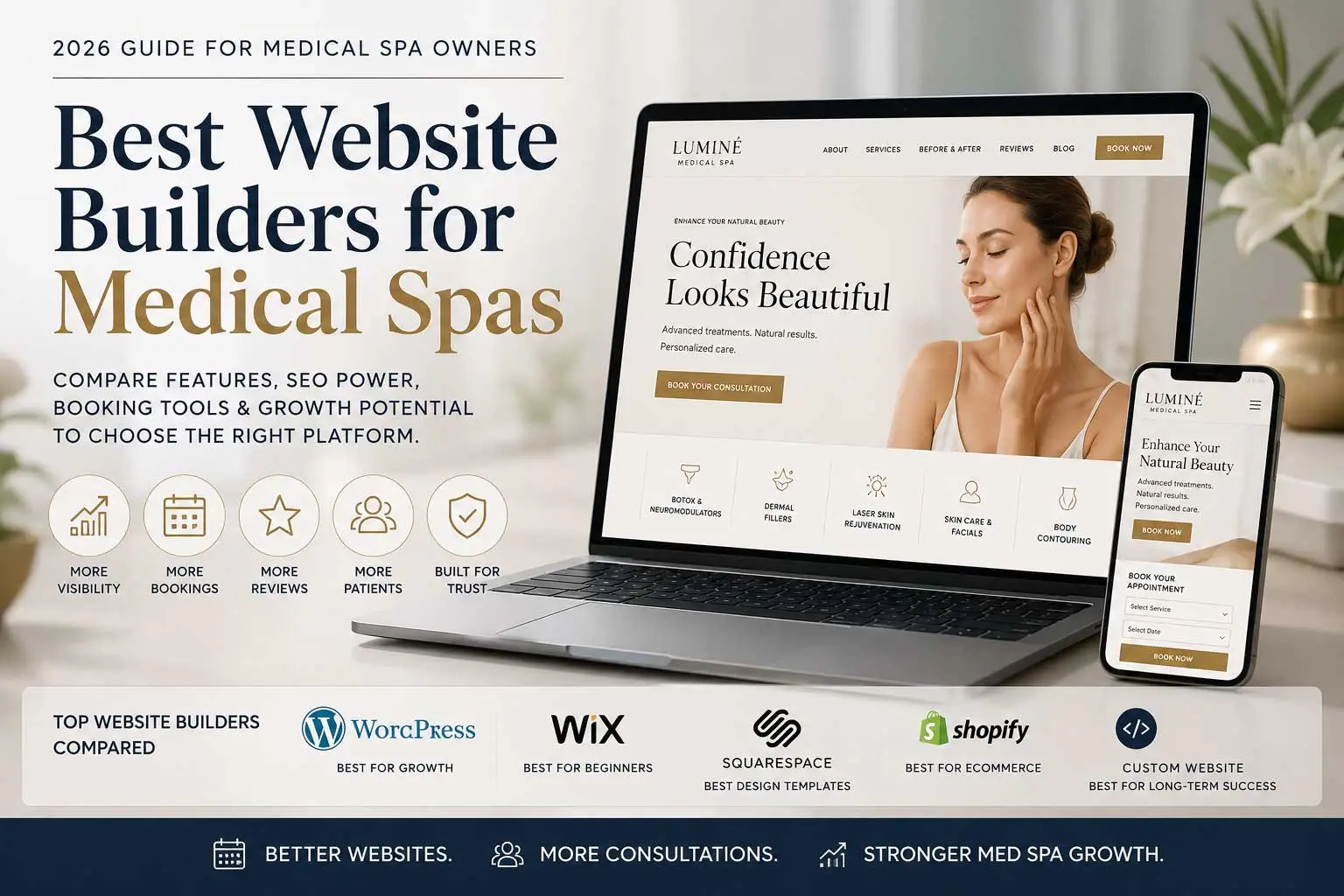
Best Website Builders for Medical Spas in 2026
TL;DR
WordPress is the best website platform for most growing medical spas because it offers stronger SEO capabilities, greater customization, and better long-term scalability than Wix or Squarespace. While drag-and-drop builders work for new practices, med spas focused on ranking in local search and generating more consultations typically benefit from a WordPress or custom-built website.
Quick Answer
The best website builder for most medical spas is WordPress because it provides stronger SEO, more flexibility, and better scalability than Wix or Squarespace. New practices may prefer Wix for simplicity, but growing med spas typically benefit from WordPress or custom-built websites.
A med spa owner recently asked a version of this question in a marketing forum, and the answers ranged from “just use Wix” to “hire a custom developer.” Both answers are technically true. Neither is useful if you are trying to make a real decision.
The problem is that website builders are often evaluated based on convenience rather than business outcomes. A platform that is easy to launch may not be the platform that helps you rank for Botox, fillers, laser treatments, and body contouring searches in your city.
For medical spas, the right website builder is the one that helps patients find you, trust you, and book consultations.
Table of Contents
- Why Your Website Platform Matters
- What Medical Spas Need From a Website Builder
- Comparing the Most Popular Website Builders
- SEO and Lead Generation Considerations
- Website Builder Comparison Table
- Real-World Example
- Frequently Asked Questions
- The Bottom Line
Why Your Website Platform Matters
Many med spa owners assume all website builders accomplish the same thing. They create pages, display treatment information, and allow visitors to contact the business.
In reality, different platforms create very different opportunities for growth. A medical spa website is not simply a digital brochure. It functions as a lead generation system, local SEO asset, credibility builder, and appointment booking tool.
According to the American Med Spa Association, patient acquisition remains one of the most important growth priorities for aesthetic practices. A website plays a central role in that process because it often serves as the first interaction between your brand and prospective patients.
A website that loads slowly, lacks treatment-specific pages, or limits SEO customization can reduce your visibility in local searches. That means fewer consultation requests and fewer opportunities to convert website visitors into paying patients.
What successful med spas prioritize
The highest-performing med spa websites generally focus on:
- Fast page speeds
- Mobile responsiveness
- Clear treatment pages
- Online booking integration
- Local SEO optimization
- Strong patient trust signals
- Easy content expansion
These factors influence rankings, user experience, and conversion rates.
What Medical Spas Need From a Website Builder
Before comparing platforms, it helps to understand what matters most.
Medical spas typically offer multiple services including Botox, dermal fillers, laser hair removal, skin rejuvenation, body contouring, and wellness treatments. Each service may require its own optimized landing page.
Search engines reward websites that provide detailed information for specific treatments. This means your website builder must support scalable content creation.
Your platform should also allow integration with scheduling systems, patient forms, CRM tools, and analytics platforms.
Another consideration is local SEO. Google emphasizes relevance, prominence, and proximity when ranking local businesses. The ability to create city-specific pages and optimize metadata can influence how often your med spa appears in local searches.
Finally, trust is critical. Visitors considering cosmetic treatments want evidence that your practice is legitimate and professional. Your website should make credentials, reviews, before-and-after galleries, and provider information easy to access.
Comparing the Most Popular Website Builders
WordPress
WordPress remains the strongest option for most growing medical spas.
The platform powers a significant portion of websites globally and offers nearly unlimited customization. It supports advanced SEO plugins, custom landing pages, booking integrations, and scalable content strategies.
For med spas investing in local SEO, WordPress provides the flexibility needed to create treatment-specific and city-specific pages.
The main drawback is that setup and maintenance require more expertise than drag-and-drop builders but its easy with Elementor.
Wix
Wix has improved substantially over the past several years.
The platform offers easy editing, attractive templates, and integrated hosting. For newer med spas that need a professional-looking website quickly, Wix can be a reasonable starting point.
However, large-scale SEO strategies can become more challenging as content expands. Complex site structures often become harder to manage than on WordPress.
Squarespace
Squarespace is known for visual design quality.
Many med spas appreciate its clean templates and user-friendly interface. It works well for businesses focused on branding and a smaller service offering.
The limitation is flexibility. As marketing strategies become more sophisticated, owners may find themselves constrained by the platform’s customization capabilities.
Shopify
Shopify is primarily designed for ecommerce.
Unless your med spa generates significant revenue through skincare products and online retail sales, Shopify is rarely the ideal choice.
It can handle appointments through integrations, but its strengths are centered around product sales rather than local lead generation.
Custom-Built Websites
Custom websites offer maximum control.
A custom build can be designed specifically around patient acquisition, local SEO, conversion optimization, and booking workflows.
While the upfront investment is higher, many established medical spas choose this route because it removes platform limitations and supports long-term growth.
Wondering whether your current website is helping or hurting your growth?
Get your free Brand Visibility Score in two minutes. It analyzes your med spa’s online presence and shows exactly where you are losing patients to competitors. No email gate. No sales call.
SEO and Lead Generation Considerations
Most website builder comparisons focus on design features.
That is not the metric that matters most.
A beautiful website that does not generate consultations has limited business value.
Medical spas compete heavily in local search results. Treatments such as Botox, fillers, laser hair removal, and microneedling often have substantial local search demand. Capturing that traffic requires pages optimized for both treatments and geographic locations.
Platforms that limit URL structures, metadata controls, schema implementation, or content scalability can create growth obstacles.
A custom WordPress website often provides the strongest foundation because it allows businesses to build extensive content libraries, create location pages, implement structured data, and optimize conversion funnels.
For example, a med spa in Scottsdale may create separate pages for Botox Scottsdale, fillers Scottsdale, and laser hair removal Scottsdale. Replicating this strategy across multiple locations becomes significantly easier on flexible platforms.
This is one reason many growing practices eventually migrate away from entry-level website builders.
Website Builder Comparison Table
Choosing the right platform depends on your goals, budget, and growth plans.
| Platform | Best For | Long-Term Growth |
|---|---|---|
| Wix | New med spas | Moderate |
| Squarespace | Design-focused practices | Moderate |
| Shopify | Product-heavy businesses | Low for service SEO |
| WordPress | Growing med spas | High |
| Custom Website | Established multi-service practices | Very High |
The key takeaway is that convenience and growth are not always aligned. Platforms that are easiest to launch are not always the platforms best suited for long-term patient acquisition.
Real-World Example
A multi-location med spa initially launched using a drag-and-drop website builder because it allowed rapid deployment.
The website looked professional and included online booking functionality. However, after two years, organic traffic growth remained limited. The practice struggled to rank for treatment-specific searches despite investing in content creation.
After migrating to a custom WordPress-based website, the business created dedicated treatment pages, city landing pages, provider profiles, FAQ content, and location-specific SEO assets.
Within the following year, organic visibility improved substantially because the website structure aligned more closely with how patients search for aesthetic services.
The lesson was not that the original platform was unusable. The lesson was that the platform had become a bottleneck once growth became the priority.
The Bottom Line
The best website builder for medical spas is not necessarily the easiest platform to use. It is the platform that supports your business goals.
If you simply need an online presence, Wix or Squarespace may be sufficient. If your goal is ranking for competitive treatment searches, generating consultations, and expanding into multiple markets, WordPress or a custom-built website typically provides a stronger foundation.
The mistake many med spa owners make is choosing a platform based solely on convenience. The better approach is choosing a platform based on where you want your business to be three years from now.
A website should not just display information. It should help generate new patient opportunities every month.
Ready to build a med spa website that actually generates patient leads?
Digital Mounts builds custom medical spa websites for a flat $7,500, delivered in 30 days, with up to 100 city-by-treatment landing pages, AI-search-ready architecture, and HIPAA-aware booking integration. No retainers. You own everything.
Related Reading
- Medical Spa Website Design Cost Guide
- Why Med Spa Websites Fail to Generate Leads
- Local SEO for Medical Spas
- Medical Spa Landing Page Best Practices
Frequently Asked Questions
What is the best website builder for a new medical spa?
For most new medical spas, Wix and Squarespace offer an affordable way to launch a professional website quickly. They include hosting, templates, and basic SEO tools without requiring technical expertise. However, if you plan to invest heavily in local SEO and content marketing, WordPress may provide more flexibility as your business grows.
Is WordPress better than Wix for medical spas?
In many cases, yes. WordPress gives medical spas greater control over SEO, website structure, content creation, and third-party integrations. While Wix is easier for beginners, WordPress typically performs better for businesses that want to rank for competitive treatment-related searches and expand their online presence over time.
Do medical spas need a custom website?
Not every medical spa needs a custom-built website from day one. Smaller practices can often start with a website builder and upgrade later. However, custom websites become valuable when your marketing strategy includes advanced SEO, multiple locations, extensive treatment pages, or conversion-focused design.
Can Squarespace rank well on Google?
Yes, Squarespace websites can rank on Google when properly optimized. The platform supports basic SEO features such as title tags, meta descriptions, and mobile-friendly design. The challenge is that advanced customization options are more limited compared to WordPress, which can affect long-term growth strategies.
How much should a medical spa website cost?
The cost varies depending on the platform and complexity of the website. DIY website builders may cost a few hundred dollars per year, while professionally designed websites often range from $3,000 to $15,000 or more. The right investment depends on your goals, competition, and expected return from new patient inquiries.
What matters more: website design or SEO?
Both are important, but they serve different purposes. SEO helps potential patients discover your medical spa through search engines, while design helps convert those visitors into consultation requests. A website needs visibility first, but it also needs a trustworthy user experience to generate bookings.
Should a medical spa have separate pages for each treatment?
Yes. Individual treatment pages help search engines understand exactly what services you offer and improve your chances of ranking for specific keywords. They also allow you to answer patient questions, showcase results, and create a more focused conversion path for each service.
When should a med spa upgrade from a website builder to a custom website?
Most med spas should consider upgrading when they begin investing seriously in SEO, paid advertising, or multi-location growth. If your current platform limits content creation, page customization, or conversion optimization, it may be holding back future growth. A custom website provides more control and scalability as your business expands.