
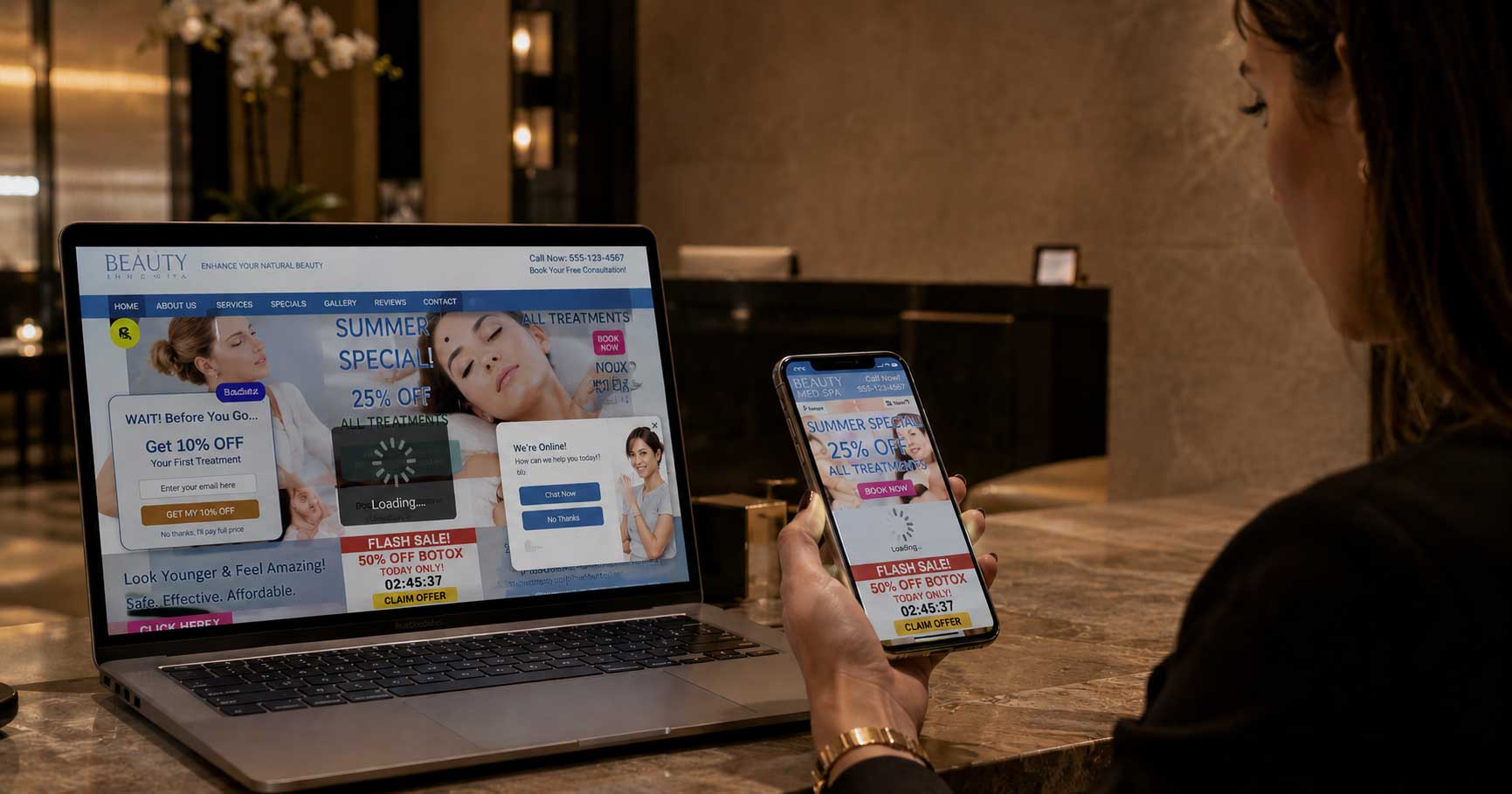
Red Flags: What NOT to Do on Your Medical Spa Website (And What’s Quietly Costing You Patients)
Here’s something that might sting a little: the average visitor decides whether to trust your medical spa website in under 3 seconds. Three seconds. That’s barely enough time to read your headline, let alone your carefully crafted “About Us” page.
And if your site has even one or two of the red flags I’m about to walk you through, that decision is almost always going to be no.
I’ve audited hundreds of med spa websites over the years, and the same mistakes keep showing up, even on sites that look expensive. The problem isn’t usually budget. It’s that most med spa owners, and even some agencies, don’t realize that aesthetic medicine has a unique trust problem. People are trusting you with their face, their body, their confidence. They’re not booking a haircut.
So let’s get into it. Here are the red flags quietly killing your conversions, your Google rankings, and your bookings, and what to do instead.
1. Stock Photos of People Who Don’t Exist
You know the ones. The impossibly perfect woman touching her face on a white background. The “doctor” in scrubs with arms crossed, smiling at nothing.
Patients can spot stock imagery instantly. And the moment they do, your credibility takes a hit you can’t recover from a few testimonials later.
What to do instead: Invest in a real photoshoot. Photograph your actual space, your actual team, and, with consent, actual treatments in progress. According to a Stanford Web Credibility study, design quality and authentic visual elements are among the top factors people use to assess trustworthiness online. Real photography signals: we have nothing to hide.
If a real shoot isn’t in the budget yet, at least source images that show your actual treatment rooms, your actual products, and avoid the obviously staged “model holding a syringe” trope.
2. Hiding Your Pricing Like It’s a State Secret
I get it. Pricing is complicated. Treatments vary. You don’t want to scare people off. You want them to “call for a consultation.”
But here’s the truth: when someone Googles “Botox near me” at 11 PM, they’re comparing you to three other spas in 30 seconds. If your competitor lists a starting price (“Botox from $12/unit”) and you don’t, guess who’s getting the call?
Hiding pricing doesn’t qualify your leads. It loses them.
What to do instead: Show starting prices, package ranges, or “treatments from $X” pricing. You don’t need to publish your full menu. You just need to give visitors enough information to feel like you’re being honest with them. Transparency converts.
3. No Real Before-and-Afters (Or Worse, Fake Ones)
Before-and-after galleries are arguably the single highest-converting element on a med spa website. They’re also where most spas get lazy or cut corners.
Common red flags:
- Generic before/afters pulled from manufacturer websites
- Photos with different lighting, angles, or filters between “before” and “after”
- A gallery of three pictures from 2019
Patients aren’t stupid. They know lighting tricks. And they definitely know when you’ve used the same Allergan stock image as the spa down the street.
What to do instead: Build a robust gallery of your own results, with consistent lighting and angles. Get patient consent in writing. Tag photos by treatment type so visitors can filter (“show me lip filler results” or “show me CoolSculpting results”). And keep adding to it. A stale gallery makes you look like you’ve stopped getting results.
4. A Website That Wasn’t Built for Mobile
Over 60% of all web traffic now comes from mobile devices, and for local service searches like “medical spa near me,” that number is even higher. If your site looks beautiful on desktop but breaks on an iPhone, tiny text, buttons that overlap, forms that won’t submit, you’re losing the majority of your potential patients before they even see your offer.
Google also uses mobile-first indexing, meaning the mobile version of your site is what determines your rankings. A non-responsive site doesn’t just hurt UX, it hurts SEO.
What to do instead: Test your site on multiple devices. Tap every button. Try to book a consultation from your phone while standing in line at Starbucks. If it’s frustrating, fix it. If you’re not sure where to start, this is exactly what a professional medical spa website design service handles end-to-end.
5. Slow Load Times That Send Patients Running
Speed matters more than most spa owners realize. Google has confirmed that page speed is a direct ranking factor, and studies show that bounce rates jump dramatically when load times exceed 3 seconds.
The usual culprits on med spa sites:
- Massive uncompressed hero images
- Auto-playing background videos
- Half a dozen marketing pixels and tracking scripts
- A bloated WordPress theme with features you’ll never use
What to do instead: Run your site through Google PageSpeed Insights and fix what it tells you to fix. Compress images. Lazy-load below-the-fold content. Remove plugins you don’t actively use. If your homepage takes longer to load than it takes a patient to text “nvm,” you have a problem.
6. Vague, Generic Treatment Pages
This one’s huge for SEO and almost everyone gets it wrong.
A “Botox” page that says “Botox is a popular cosmetic treatment that reduces wrinkles. Contact us today!” is doing absolutely nothing for you. Not for Google. Not for AI search engines like ChatGPT and Perplexity, which are increasingly how patients research providers. Not for the patient on the fence.
What to do instead: Build out genuinely useful treatment pages that answer real patient questions:
- What does the treatment actually do?
- What does it feel like?
- How long does it take?
- What’s the downtime?
- Who’s a good candidate, and who isn’t?
- What does it cost at your spa?
- What does recovery look like?
This kind of in-depth, specific content is what gets cited by AI search and ranks on Google. Generic content gets ignored by both.
7. No Clear Call-to-Action (Or Twelve of Them)
Look at your homepage right now. What’s the one thing you want a visitor to do?
If your answer is “book a consultation, follow us on Instagram, sign up for our newsletter, download our guide, and shop our products,” your visitors are going to do none of them.
Decision fatigue is real, especially when someone is already nervous about the idea of cosmetic treatment.
What to do instead: Pick one primary CTA per page, usually “Book a Consultation,” and make it impossible to miss. Use it in the header, after the hero, between sections, and at the bottom. Secondary CTAs are fine, but they should never compete with the primary one.
8. Missing or Buried Trust Signals
Med spa patients are doing more research than ever before they book. They want to know:
- Who’s actually performing the treatment?
- What are their credentials?
- Is this place licensed and reputable?
- What do real patients say?
If your site doesn’t surface this information clearly, you’re forcing them to leave and find it elsewhere, which often means landing on Google reviews or Reddit threads where you have zero control over the narrative.
What to do instead: Put credentials, licensing, certifications, real provider bios with real photos, and recent verified reviews front and center. If you’ve been featured in any local press or industry publications, show those logos. The goal is to answer “should I trust them?” before the question even fully forms.
For more on building trust through your overall digital presence, our guide to digital marketing for medical spas covers strategies that complement great web design.
9. Ignoring Local SEO Completely
Most med spa traffic is local. If you’re a spa in Austin, you don’t need to rank for “best Botox in America.” You need to rank for “Botox Austin” and “med spa near me” within a 15-mile radius.
Yet most med spa websites do almost nothing to signal location to Google:
- No city or neighborhood mentioned in title tags or H1s
- No embedded Google Map
- No NAP (Name, Address, Phone) consistency across the site
- No location-specific landing pages if they have multiple locations
- A neglected or unclaimed Google Business Profile
What to do instead: Bake your location into your SEO from the foundation up. Create dedicated location pages if you serve multiple cities. Optimize your Google Business Profile. Use schema markup to help search engines, and AI tools, understand exactly where you’re located and what you offer.
10. Auto-Playing Audio or Video
I shouldn’t have to say this in 2026, but I do. If a patient lands on your site at work and your hero video blasts spa music at full volume, they’re closing the tab.
Same goes for chatbots that pop up the second the page loads with “Hi! Can I help you?” before the visitor has even read your headline.
What to do instead: Let people explore on their own terms. Videos can be there, just keep them muted by default. Chat widgets can stay, just delay them or make them less aggressive.
11. Forgetting That AI Search Is the New Google
This one isn’t on most med spa owners’ radar yet, but it should be. More patients are using ChatGPT, Perplexity, Gemini, and Claude to research treatments and providers. AI search engines pull information from websites that are well-structured, content-rich, and trustworthy.
If your site is thin on content, full of generic copy, and lacks clear answers to common patient questions, you’re invisible to this new layer of search.
What to do instead: Write content that answers questions in clear, structured ways. Use proper headings. Include FAQs. Build out comprehensive treatment pages. The same things that make a site great for patients also make it great for AI to cite.
12. DIY-ing It on a Generic Template
I’ll say this gently: a generic Wix or Squarespace template, built by someone whose main qualification is “watched a YouTube tutorial,” is going to look exactly like what it is.
Med spas are not pizza shops. The trust threshold is higher. The visual standard is higher. The competition is fiercer. A template designed for a generic small business is not going to give you the conversion rates, the SEO foundation, or the brand presence you need to compete with the spa across town that took this seriously.
So, What’s the Fix?
If you read through this list and felt your stomach drop a few times, good. That means you actually care about your business. The med spa owners who blow past these red flags without recognizing them are the ones whose phones stop ringing six months from now and they can’t figure out why.

A great medical spa website isn’t just pretty. It’s:
- Fast (under 3 seconds load time)
- Mobile-perfect (because most of your traffic is on phones)
- Visually authentic (real photos, real results, real people)
- Strategically written (for both patients and search engines)
- Conversion-focused (one clear path, one clear ask)
- Locally optimized (so the right people find you)
- Built to last (not a template you’ll outgrow in a year)
This is exactly what we do at Digital Mounts. We don’t build generic websites with a “med spa” filter slapped on top. We build sites strategically designed for aesthetic practices, sites that book consultations, rank on Google, and earn citations from AI search.
If you’ve been quietly suspecting your current site is leaving money on the table, you’re probably right. And we can help.
Frequently Asked Questions About Medical Spa Website Red Flags
What is the biggest red flag on a medical spa website?
Generic stock photos of fake doctors and models. Patients can spot stock imagery instantly, and it damages credibility before they even read your services. Real photos of your actual space, team, and treatment results are essential for building trust on a med spa website.
Should I show pricing on my medical spa website?
Yes, at least starting prices or package ranges. Hiding pricing rarely qualifies leads. More often, it pushes visitors toward competitors who are more transparent. When potential patients compare multiple med spas in under a minute, clear pricing helps build trust and captures high-intent searches. Even simple pricing like “Botox from $12/unit” can improve conversions.
How fast should a medical spa website load?
Under 3 seconds, ideally closer to 2. Google considers page speed a ranking factor, and bounce rates increase significantly once load times pass the 3-second mark. Running your website through Google PageSpeed Insights is a good way to identify performance issues slowing the experience down.
Do medical spa websites need to be mobile-optimized?
Absolutely. Most med spa traffic now comes from mobile devices, and Google uses mobile-first indexing, meaning your mobile experience directly affects your rankings. A website that feels clunky on a phone hurts both SEO and patient trust.
How much does a professional medical spa website cost?
Professional medical spa websites typically range from $3,000 to $15,000+ depending on the level of customization, SEO setup, integrations, and conversion strategy involved. A strategically built website designed to drive consultations often pays for itself through increased bookings and patient retention.
Can I build my medical spa website on Wix or Squarespace?
You can, but it may limit long-term growth for competitive med spas. Generic templates often lack the conversion architecture, SEO depth, scalability, and premium brand positioning needed in aesthetic medicine. Custom-built websites generally outperform templates when it comes to rankings, trust, and booked consultations.
Ready to Build a Med Spa Website That Actually Brings in Patients?
Whether you’re starting from scratch or your current site is silently killing your bookings, our team specializes in high-converting, search-optimized websites built specifically for medical spas.
Explore our Medical Spa Website Design service →
Let’s turn your website from a red-flag liability into your best-performing salesperson, one that works 24/7, never calls in sick, and never lets a qualified lead slip away.